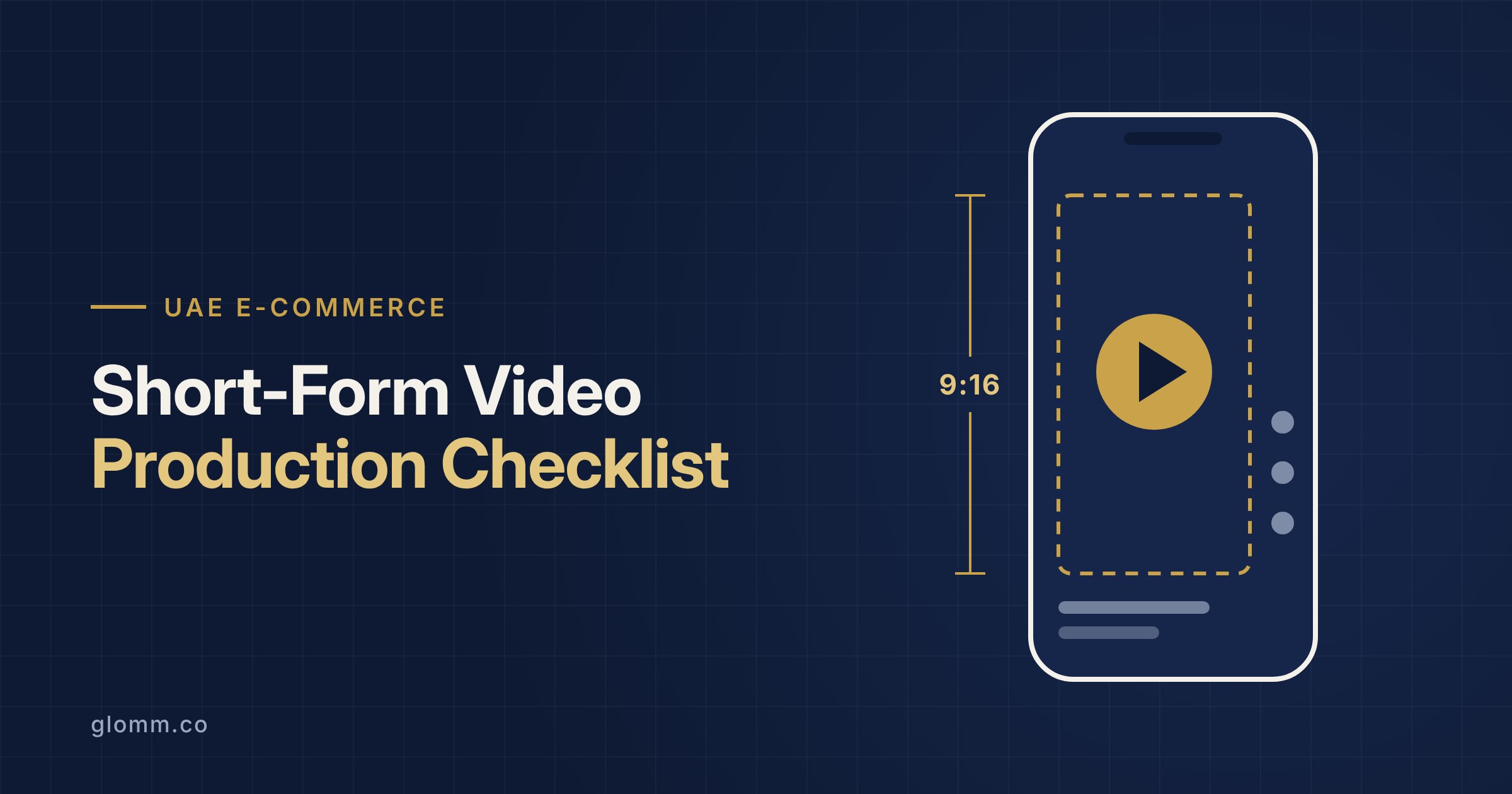
This short-form video production checklist UAE luxury e-commerce brands can follow has five stages: plan the goal and the bilingual script, shoot natively in 9:16 at 1080×1920 with the product’s true colour and texture protected, edit separate Arabic and English versions with captions kept inside platform safe zones, clear the legal items (permits, music, talent, AI disclosure), then test one variable at a time and judge results by sales and returns, not views.
Luxury shoppers in the UAE judge a brand in the first seconds of a Reel, and a clip that looks cheap, mistranslated or inaccurate costs more than the production budget saved. This checklist is written for brand and e-commerce teams, and it covers the decisions that go wrong most often. Tick items off as you go. Where something depends on a rule that changes (platform limits, permits, AI labels), we say so and tell you what to check.
Table of Contents
ToggleQuick Answer
Before you shoot, define one goal and one metric, write the Arabic and English scripts separately, and clear talent, music and permits. On set, shoot vertical 9:16 at 1080×1920, protect the product’s real colour, and capture several versions of the opening.
In the edit, make separate Arabic and English cuts with captions inside the safe zones. Before launch, check the UAE Advertiser Permit for any creator and label any realistic AI content. After launch, test one variable at a time and track sales and returns.
What Are the Technical Specs for TikTok, Reels and Shorts?
All three platforms use a vertical 9:16 frame at 1080×1920 pixels, so one master file can cover them. Length limits, file sizes and the exact area covered by on-screen buttons differ and change often, so check each platform’s current documentation before a big production.
| TikTok | Instagram Reels | YouTube Shorts | |
|---|---|---|---|
| Aspect ratio and resolution | 9:16, 1080×1920 | 9:16, 1080×1920 | 9:16, 1080×1920 |
| Length | Allows long uploads; aim far shorter | Limits have changed several times; check Instagram’s current limit | Up to 3 minutes |
| Codec guidance | H.264 video, AAC audio | H.264 video, AAC audio | Check YouTube’s recommended encoder settings |
Two cautions on safe zones. No platform publishes binding pixel values for them, so the numbers you’ll see in guides are reverse-engineered from the current apps. As a working rule, keep captions and logos away from the right edge and from roughly the bottom 250 to 350 pixels, where captions, profile names and buttons sit, then test on real phones. And “maximum length” is what’s technically allowed, not what to aim for. Short-form is a retention game, so make the video as long as the story needs and no longer.
Stage 1: What Should You Decide Before You Shoot Short-Form Video?
Decide the goal, the audience, the bilingual script, the people on camera, the music and the permits before anyone picks up a camera, because mistakes found on set or in the edit cost far more than mistakes found in a planning meeting.
- ☐ One goal and one metric per video. Add-to-cart, new customers, or a launch waitlist. Not “awareness and sales and followers”.
- ☐ A named audience and market. UAE-based shoppers, Saudi shoppers, or tourists? The tone, language and offer differ, and our guide to digital marketing across the Northern Emirates shows how different even neighbouring emirates can be.
- ☐ Arabic and English scripts written separately. Write the Arabic natively rather than translating the English afterwards. See our guide to Arabic and bilingual content for AI search for the Modern Standard vs Gulf Arabic trade-off. As a rule of thumb, clear Modern Standard Arabic suits explanatory voice-over and captions, while a Gulf tone suits conversational creator content.
- ☐ A shot list for every version, including the first three seconds. Plan at least three different openings so you can test them.
- ☐ A cultural review. UAE media rules prohibit content that offends religion, national symbols or public morals, so have someone who knows the market review concepts, wardrobe and music before the shoot, not after.
- ☐ Talent and creators cleared. Written consent, the usage term, the platforms and whether paid advertising is covered. Under the UAE Media Council’s rules (as reported by Gulf News), anyone creating promotional content from within the UAE needs an Advertiser Permit (required since 1 February 2026, for paid and unpaid promotion), and organisations are expected to check that creators they work with hold a valid one. Check the permit number is displayed on the creator’s profile.
- ☐ Music licensed for commercial use. Trending sounds are often restricted to personal accounts, so use tracks you’ve licensed or the commercial libraries each platform provides, and check the platform’s current rules.
- ☐ Locations and drones. Check what permissions you need to film in public places or fly a drone, with the relevant Dubai or UAE authority, before the shoot day.
- ☐ A calendar. Work back from Ramadan, Eid, White Friday, National Day and the Dubai Shopping Festival, and allow time for edits in two languages.
Stage 2: What Should You Capture on the Shoot Day?
Shoot natively in vertical, protect the true colour and texture of the product, record clean audio, and capture extra openings and close-ups, because a high-end brand’s biggest risk on set is a product that looks different on screen from what arrives in the box.
- ☐ Shoot vertical 9:16, not a cropped landscape frame, and keep the main subject in the centre of the frame.
- ☐ Colour accuracy. Use a grey card or colour chart in the first take of each setup. Fashion and beauty returns often come from “it looked different on video”.
- ☐ Texture and detail. Capture macro shots of stitching, finish, clasps, fabric movement and packaging, in good light.
- ☐ Scale and use. Show the product on a body or in a hand, so the viewer understands size.
- ☐ Three or more hooks. Shoot different first seconds: the product in motion, the problem it solves, a close detail.
- ☐ Clean audio. Even if the final uses music, record room tone and any Arabic or English voice-over in a quiet space.
- ☐ Pick-ups and B-roll for alternative cuts, and a second pair of eyes on the monitor.
- ☐ Backups. Copy the day’s footage to two places before anyone leaves.
Stage 3: How Should You Edit Short-Form Video for the UAE Market?
Edit separate Arabic and English versions with captions inside the safe zones, check that Arabic text renders correctly, and make sure the video still makes sense with the sound off.
- ☐ Separate Arabic and English cuts, not an English video with Arabic subtitles squeezed in underneath.
- ☐ Right-to-left layout. Arabic captions need right-aligned text, a proper Arabic typeface and joined letters that render correctly. Check every export on a phone, because many editing tools break connected Arabic letters.
- ☐ Sound-off comprehension. Many people watch with the sound off, so the idea should land on captions and visuals alone.
- ☐ Colour matched to the real product. Restrained grading suits a premium brand, and heavy filters create returns.
- ☐ A clear cover frame that looks good in the profile grid.
- ☐ A version matrix. Decide the length cuts, the languages, the calls to action and the platform exports up front, and name files consistently, for example brand_product_AR_15s_v2.mp4.
- ☐ Export 1080×1920, H.264 video and AAC audio.
A simple starting structure for a 20 to 30 second product video, not a formula: an opening that shows the product or the problem at once, a few seconds of proof such as the product in use, one or two details that justify the price, then a single clear call to action. Test it, and change it if the data says so.
Stage 4: What Compliance Items Should You Clear Before Launch?
Clear claims, permits, rights and AI disclosure before publishing, because a takedown, a platform rejection or a regulator’s attention costs more than a delayed launch.
- ☐ Claims you can prove. Prices, offers, materials, “handmade”, “limited edition” and any before-and-after result should be accurate and documented. Misleading advertising is a consumer protection issue in the UAE.
- ☐ Advertiser Permit check for every creator, as above. Planning a creator-led campaign? See how we run influencer marketing in Dubai.
- ☐ Rights cleared for music, footage, locations and people.
- ☐ AI disclosure. If any part of the video uses realistic AI-generated imagery, voice or people, label it where the platform requires. TikTok requires realistic AI-generated content to be labelled and reads provenance data to auto-label it, and since 21 July 2026 its ad policy also requires an AI disclosure label on ads with realistic AI-generated content. YouTube requires creators to disclose realistic synthetic content. Policies change, so check each platform’s current rules for ads, and see our guide on AI visuals vs studio shoots for how to decide when AI is appropriate at all.
- ☐ Product feeds. Google’s guidance for Merchant Center asks that AI-generated product images carry specific metadata, and that AI-generated titles and descriptions are labelled as such.
Stage 5: How Should You Launch and Measure Short-Form Video Ads?
Test one variable at a time, define success before launch, and judge each video by sales, add-to-cart rate and returns, not views, because a video that gets attention but sends back wrong-expectation orders hurts more than it helps.
- ☐ Tracking in place. UTM parameters on every link, and the product catalogue connected.
- ☐ One variable per test. Change the hook, or the language, or the length, not all three together.
- ☐ Metrics defined in advance. Watch time or hold rate, click-through, add-to-cart, conversion rate, cost per acquisition and average order value, plus return rate by creative.
- ☐ A fair test window. Don’t call a winner from the first day’s data.
- ☐ A refresh plan. Audiences tire of creative, so schedule new variations from your pick-ups and B-roll.
- ☐ A debrief. Record what you learned and update the shot list template for next time.
Bottom Line
A good short-form production for a premium UAE brand is mostly decisions made before the camera rolls: one goal, two natively written languages, cleared talent and music, and a plan for what you’ll test. Protect the product’s true appearance, make the Arabic as good as the English, clear the permit and disclosure items, and judge results by sales and returns. If you’d like help planning or producing it, see our video production services or contact Glomm.
Frequently Asked Questions
As long as the idea needs. Platforms allow much longer videos than most ads need, so treat the maximum as a limit, not a target, and test two or three lengths.
For a UAE and Saudi audience, usually yes. Separate cuts let captions, voice-over and pacing fit each language, and they avoid awkward text layout.
The UAE Media Council has required an Advertiser Permit for anyone creating promotional content from within the UAE since 1 February 2026, for paid and unpaid promotion. Brands are expected to check their creators hold one. Confirm the current rules and your own obligations with a UAE adviser.
Sometimes, for variants and backgrounds, but it needs care around accuracy and disclosure. We cover the decision in our companion guide.
Over-filtered colour, generic trending audio, text that fights the safe zones, and claims that go beyond what the product does.