
By Prachi Bishnoi, Founder, Glomm
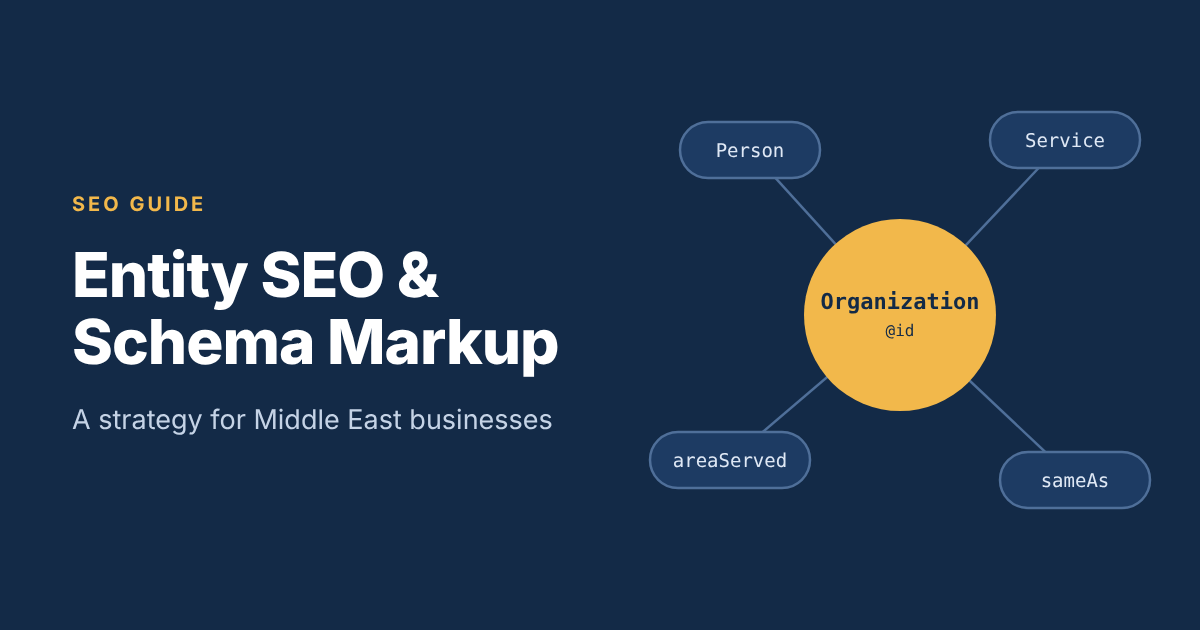
Entity SEO and schema markup solve two different problems that get treated as one. Entity SEO is the work of making your business a recognised, unambiguous “thing” in Google’s Knowledge Graph and in the data AI systems draw on: business registries, consistent listings, authoritative media. Schema markup is structured code (JSON-LD) that labels your pages so machines read them correctly. Google’s own documentation says Organization markup can help “disambiguate your organization in search results”. It does not say it creates rankings, Knowledge Panels or AI citations. For a Middle East business working in English and Arabic across several GCC markets, that distinction separates a real entity strategy from a schema plugin that does nothing.
Table of Contents
ToggleQuick Answer
Entity SEO builds your brand’s recognition as a real, verifiable entity through consistent business information, genuine third-party mentions and clear organizational relationships.
Schema markup, in Google’s recommended JSON-LD format, is the machine-readable layer that states those relationships on your own pages: Organization for your core identity, Local Business for each genuine office, Service with area Served for markets you serve without an office, and parent Organization/sub Organization to show how a UAE headquarters relates to a Saudi subsidiary.
For GCC businesses, the code is the easy part. The hard part is keeping one consistent entity across English and Arabic, several countries, and dozens of directory listings.
From “Strings to Things”: Why This Matters More Than It Used To
Google has worked with entities rather than keyword strings since 2012, when it launched the Knowledge Graph under the phrase “things, not strings”. Generative AI search has raised the stakes, because a system choosing which brand to name in an answer has to be confident which real-world organisation a name refers to.
In 2020, its last major public disclosure, Google said the Knowledge Graph held around 500 billion facts about 5 billion entities. In practice, Google does not just index the text “Glomm” on a page. It tries to work out whether that string refers to one consistent, real organisation or to several different ones that share a name.
AI answers make this more visible. A Semrush and Datos study of more than 10 million keywords found AI Overviews on 13.14% of US desktop searches in March 2025, up from 6.49% in January 2025. That is a dated, US-only snapshot, but the direction is what matters: more answers are being written by systems that must pick a brand to name, and a brand they can verify is easier to pick than one they cannot.
A Real Example: When Two Companies Share Your Name
We have this problem ourselves. Glomm is a marketing agency in Dubai. Glomm Spedition is an unrelated logistics company in Germany. Search the bare word “Glomm” and a search engine has two legitimate candidates in different industries and countries, and no reason to assume you meant us.
No single tag fixes that. What helps is the combination this article describes:
- One primary entity definition on the homepage: name, legal name, address, founder and industry, declared once and referenced everywhere else by @id.
- Identifiers the other company cannot share: our Dubai address, our founder, and sameAs links pointing only to profiles we control.
- Consistent wording off-site: the same name, description and location on LinkedIn, Crunchbase, Google Business Profile and agency directories.
- Independent mentions that tie the name to Dubai and to marketing, so the association does not rest on our own claims.
Name collisions are common across the GCC, where trading names built on words like Al Noor, Emirates or Gulf repeat across sectors and countries. If your brand name is not unique, disambiguation is the first job of your schema, ahead of any rich result.
What Schema Markup Actually Does, According to Google
Schema markup is structured data, most commonly written in JSON-LD, that describes a page using the Schema.org vocabulary. Google’s Organization documentation frames its purpose as helping Google understand a company’s administrative details and tell it apart from others. The verb is disambiguate, not rank.
The same documentation states that Organization markup has no strictly required properties, and it lists business identifiers such as iso6523 and naics specifically for separating one organisation from others with similar names. That matters directly in a region where near-identical trading names are routine.
What Schema Does Not Do
- It is not a direct ranking factor. Google’s representatives have said so repeatedly.
- It does not guarantee a Knowledge Panel.
- It does not guarantee citation in AI Overviews, ChatGPT or Gemini.
- It cannot replace independently verifiable information about your organisation elsewhere on the web.
There is a measured upside. Google’s own case study reports that Rotten Tomatoes saw a 25% higher click-through rate on pages with structured data. That is a rich-result and click-through effect, not a ranking effect, and it is the realistic ceiling of what markup alone delivers.
The GCC-Specific Problem: Entity Fragmentation
Middle East businesses fragment their own entity signals more than most. One organisation often exists as a UAE headquarters, a Saudi subsidiary, an English site, an Arabic site and several branches. Unless those relationships are declared, Google has no reliable way to know they are one entity.
| Challenge | Impact on search engines | Fix |
|---|---|---|
| English/Arabic brand split | The two language versions can be read as separate entities | Give both versions the same @id and declare the official Arabic name as alternateName |
| Multiple GCC country entities | Google cannot tell a subsidiary from an unrelated company | Declare parentOrganization / subOrganization, only where the legal relationship is real |
| Inconsistent NAP across directories | Lower confidence in any single version of the business | Standardise name, address, phone and website on every Google Business Profile and directory, per country. See our guide to local SEO in Ras Al Khaimah [INTERNAL LINK: “local SEO in Ras Al Khaimah” → live post “Local SEO in Ras Al Khaimah: How RAK Businesses Get Leads”] |
| No independent verification | Nothing to cross-check your self-declared schema against | Earn genuine coverage in trusted regional press (Khaleej Times, Gulf News, WAM). Wikidata helps only if the company meets its notability rules, so do not create an entry that will be deleted |
A Worked Example: A Dubai Agency Serving Sharjah and Ras Al Khaimah
Here is the structure applied to Glomm itself: a marketing agency in Dubai, with its one office there, serving Sharjah and Ras Al Khaimah as distinct markets without offices in either. Those are the two markets compared in our digital marketing guide to the Northern Emirates.
The key decision is how to describe Sharjah and RAK. A market you serve is not an office. LocalBusiness is for a physical location customers can visit, with a full street address. For a city you serve from elsewhere, the accurate markup is a Service with areaServed, linked back to the one Organization.
<script type=”application/ld+json”>
{
“@context”: “https://schema.org”,
“@graph”: [
{
“@type”: “Organization”,
“@id”: “https://glomm.co/#organization”,
“name”: “Glomm”,
“legalName”: “Glomm Digital”,
“url”: “https://glomm.co/”,
“logo”: “https://glomm.co/logo.png”,
“description”: “Marketing agency in Dubai, UAE.”,
“founder”: {
“@type”: “Person”,
“@id”: “https://glomm.co/#founder”,
“name”: “Prachi Bishnoi”,
“jobTitle”: “Founder & Chief Creative Officer”
},
“address”: {
“@type”: “PostalAddress”,
“addressLocality”: “Dubai”,
“addressCountry”: “AE”
},
“areaServed”: [
{ “@type”: “City”, “name”: “Dubai” },
{ “@type”: “City”, “name”: “Sharjah” },
{ “@type”: “City”, “name”: “Ras Al Khaimah” }
],
“sameAs”: [
“https://www.linkedin.com/company/glomm”,
“https://www.crunchbase.com/organization/glomm”
]
},
{
“@type”: “Service”,
“@id”: “https://glomm.co/marketing-agency-sharjah/#service”,
“name”: “Digital marketing services in Sharjah”,
“url”: “https://glomm.co/marketing-agency-sharjah/”,
“provider”: { “@id”: “https://glomm.co/#organization” },
“areaServed”: { “@type”: “City”, “name”: “Sharjah” }
},
{
“@type”: “Service”,
“@id”: “https://glomm.co/marketing-agency-ras-al-khaimah-rak/#service”,
“name”: “Digital marketing services in Ras Al Khaimah”,
“url”: “https://glomm.co/marketing-agency-ras-al-khaimah-rak/”,
“provider”: { “@id”: “https://glomm.co/#organization” },
“areaServed”: { “@type”: “City”, “name”: “Ras Al Khaimah” }
}
]
}
</script>
Four things this structure gets right:
- One organisation node. The Sharjah agency page and the Ras Al Khaimah agency page point to the same @id instead of redefining the company on each page.
- No invented offices. Service areas are declared as service areas. If an office opens in Sharjah, that node becomes a LocalBusiness with its real address on the same day.
- Disambiguating details. legalName, founder and a Dubai address are facts a same-named company elsewhere cannot share.
- A short, verified sameAs list. Only profiles the company controls.
The Bilingual Layer: One Entity, Two Languages
For a company with official English and Arabic names and a legally separate Saudi entity, the pattern extends as below. The company is fictional, used so the Arabic can be shown correctly.
{
“@context”: “https://schema.org”,
“@graph”: [
{
“@type”: “Organization”,
“@id”: “https://alnoortrading.example/#organization”,
“name”: “Al Noor Trading”,
“alternateName”: “النور للتجارة”,
“url”: “https://alnoortrading.example/”,
“address”: {
“@type”: “PostalAddress”,
“addressLocality”: “Dubai”,
“addressCountry”: “AE”
},
“subOrganization”: { “@id”: “https://alnoortrading.example/sa/#organization” }
},
{
“@type”: “Organization”,
“@id”: “https://alnoortrading.example/sa/#organization”,
“name”: “Al Noor Trading KSA”,
“alternateName”: “النور للتجارة السعودية”,
“parentOrganization”: { “@id”: “https://alnoortrading.example/#organization” },
“address”: {
“@type”: “PostalAddress”,
“addressLocality”: “Riyadh”,
“addressCountry”: “SA”
}
}
]
}
Three rules make this work. Use the Arabic name exactly as it appears on the trade licence or commercial registration, never a phonetic guess: a wrong Arabic name in production schema damages disambiguation. Serve the same @id from the English and Arabic versions of each page, so both languages describe one entity. And keep hreflang annotations between the two versions correct, because schema does not tell Google which page is the translation of which.
Schema Types Worth Prioritising
| Schema type | Best for | What it enables |
|---|---|---|
| Organization | Homepage, about page | Brand identity, logo, disambiguation from similarly named companies |
| LocalBusiness | Genuine branch or office pages | Address, hours and contact details for a real location |
| Service | Service and service-area pages | States what you offer and where, without claiming an office |
| Person / ProfilePage | Leadership and named experts | Entity clarity for individuals tied to the organisation |
| Article / BlogPosting | Blog and resource content | Author, date and headline understood correctly |
| BreadcrumbList | Any deep page | Breadcrumb trail in desktop results in place of a raw URL |
| FAQPage | Genuine Q&A sections | Machine-readable questions and answers. Google retired FAQ rich results on 7 May 2026, so it no longer produces accordions in search |
The sameAs Property: Identity Confirmation, Not a Link List
Schema.org defines sameAs as the URL of a reference page that unambiguously identifies the entity: an official LinkedIn page, a Wikidata entry, a verified social profile. The goal is confirmation, not volume. A listing with outdated details, or a handle that belongs to a different company with a similar name, works against you. For a brand with a name collision, one wrong sameAs URL can point Google at the very company you are trying to be distinguished from.
Five Entity SEO Mistakes That Undermine the Strategy
- Copying the same Organization block onto every page regardless of what the page represents.
- Creating location entities for cities with no real office, such as a Riyadh LocalBusiness added only to rank for “company name + Riyadh”.
- Using several versions of the company name across the website, directories and social profiles.
- Treating schema as a ranking shortcut instead of a complement to content, technical SEO and authoritative mentions.
- Letting markup go stale. An address, executive or subsidiary that changes in reality but not in the JSON-LD becomes a quality problem. Google requires markup to reflect what is visible and current on the page.
Building an Entity SEO Strategy: 6 Steps
- Build an entity inventory: every legal entity, brand, subsidiary, location, service and named executive.
- Establish the primary entity: one official name, URL, logo and description, used identically everywhere.
- Map the relationships: parent to subsidiary to branch, and organisation to service to location.
- Implement the right schema per page, not one template pasted site-wide.
- Align external profiles: Google Business Profile, LinkedIn and directories should match the JSON-LD exactly.
- Monitor and maintain: new offices, executives and acquisitions require markup updates, not only website updates.
How to Measure Entity SEO
Keyword position is a weak indicator here. Better ones: branded search clicks and click-through rate, whether a search for your brand or your executives’ names returns your own properties first, valid structured-data items in Search Console, and mentions from authoritative regional sources. A Knowledge Panel or an AI citation cannot be triggered by schema. Treat them as evidence the wider entity work is succeeding.
Frequently Asked Questions
Does schema markup improve Google rankings? Not directly. Google describes Organization markup as a way to understand and disambiguate an organisation. It can improve click-through where a rich result is still available, which is a different effect.
Can schema markup get my company a Knowledge Panel? No. Schema supports disambiguation, but a Knowledge Panel depends on Google holding enough independently verified information about the entity.
Should the Arabic and English versions of my site use different organisation names? Use the official name in each language, and make both resolve to one entity through a shared @id and alternateName. Do not present them as two unrelated identities.
Do I need LocalBusiness schema for every GCC city I work in? Only for genuine physical locations. For cities you serve without an office, use Service markup with areaServed.
Is FAQ schema still worth adding? Only where the page has real questions and answers. Google stopped showing FAQ rich results in May 2026. The markup remains valid and harmless, but it is no longer a way to gain space in search results.
Is entity SEO required to be cited by ChatGPT or Gemini? No schema type guarantees AI citation. Consistent information about who you are across many independent sources supports it. Markup alone is not enough.
Bottom Line
Schema markup is the smaller part of the job: a few hours of correctly structured JSON-LD. Entity SEO is the larger part: consistent naming across every directory and language, relationships declared only where they are real, and independent sources Google can cross-check. For a GCC business working in two languages across several markets, that larger part decides whether you are understood as one coherent, trustworthy entity by Google and by whichever AI system a customer asks first.
Want your entity signals audited? Glomm reviews schema, listings and brand search results for businesses across the UAE and GCC. Talk to our SEO team