
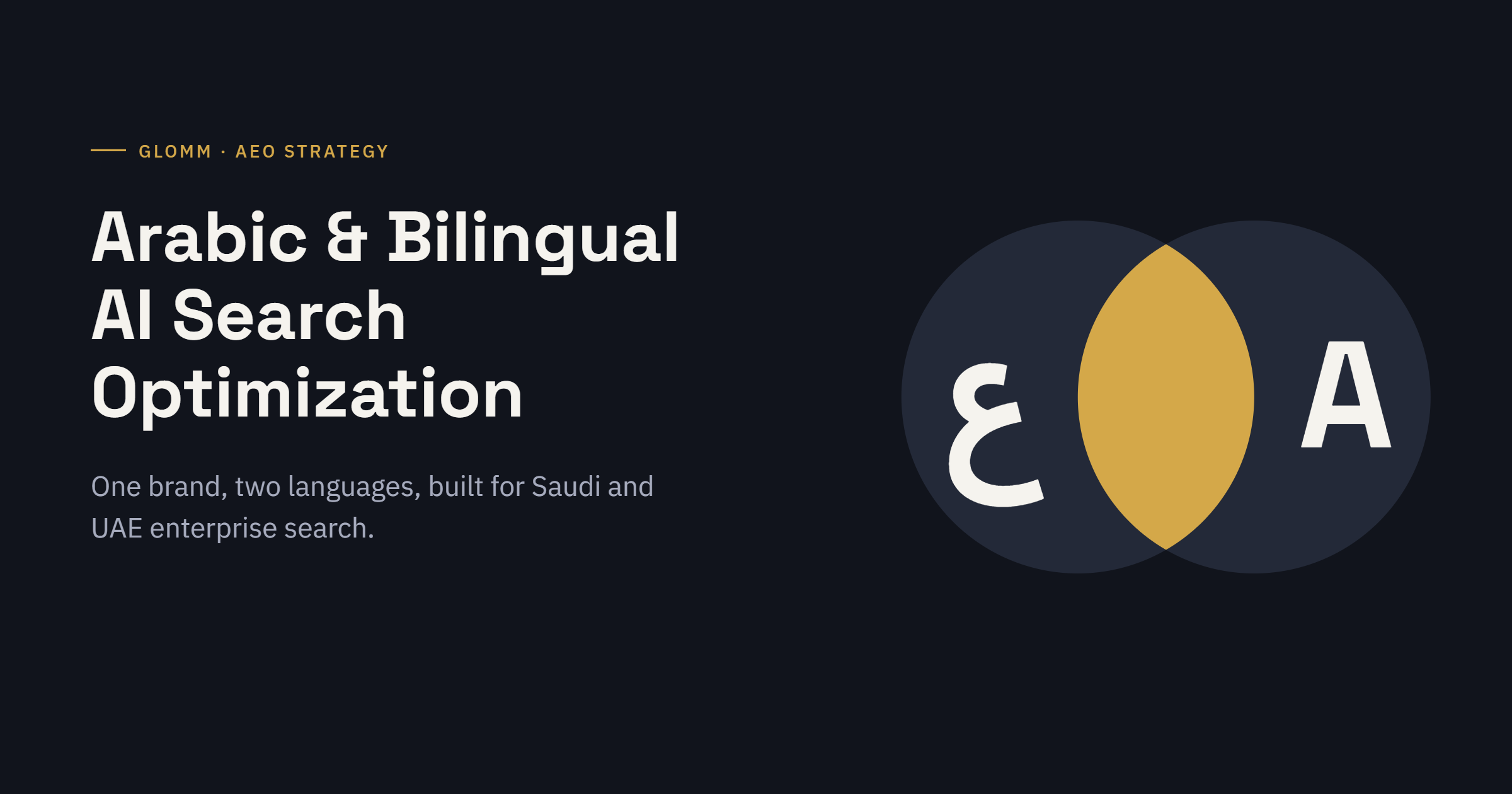
Arabic and bilingual generative AI optimization means making your content easy for AI systems to find, understand, and cite in both Arabic and English: separate, correctly tagged language pages, Arabic written natively rather than translated, one consistent brand identity across both scripts, and structured data that ties every version to the same entity. Google’s AI Overviews and AI Mode both work in Arabic now, so an English-only strategy hands every Arabic answer to a competitor.
Most of the advice on this topic is a single line: “translate your site into Arabic.” That’s the part that matters least. The harder questions are which Arabic to write, how to keep your brand from splitting into two unrelated entities, and how to find out whether any AI system is actually citing you in Arabic. This guide covers all three for enterprises selling into Saudi Arabia and the UAE.
Table of Contents
ToggleQuick Answer
To win citations in Arabic and bilingual AI search, build separate Arabic and English pages with reciprocal hreflang tags, write the Arabic natively (clear Modern Standard Arabic for the answers you want cited, a Gulf tone for marketing copy), keep your brand name and Organization schema consistent across both languages, and test real Arabic prompts across ChatGPT, Gemini, and Perplexity on a schedule. Never publish machine translation at scale without human review and added value: Google’s spam policies treat many low-value pages as scaled content abuse, however they’re produced.
A note on tactics: Google’s own guide to generative AI search says you don’t need special markup, llms.txt files, or content split into tiny chunks to appear in its AI features, and that writing separate pages for every phrasing of a question to manipulate results violates its spam policy. Nothing in this guide asks you to do that. The advice here is about serving Arabic and English readers well and making sure crawlers can reach and pair your language versions.
Why Is Arabic AI Search Different From English?
Arabic AI search differs because the systems answering the question were trained mostly on Modern Standard Arabic (MSA), while people search, speak, and write in dialects, and because Google rolled out its Arabic AI features in stages that matter for how you plan.
The timeline is worth knowing:
- May 2025: Google expanded AI Overviews to more than 40 additional languages, Arabic included, and AI Overviews are now live for users in the UAE and Saudi Arabia.
- August 2025: AI Mode launched in English across the Middle East and North Africa.
- October 2025: AI Mode launched in Arabic. Google’s announcement specifies Modern Standard Arabic (Fusha), not dialects.
Two details from Google’s own announcement matter for content strategy. First, Google says early AI Mode users ask questions two to three times longer than traditional search queries. Second, AI Mode uses what Google calls query fan-out: it splits one question into subtopics and runs many searches at once. The practical consequence is that a single, thin page targeting one keyword is a weak fit. A page that answers the main question and the obvious follow-ups is a better one.
Then there’s the model side. Published Arabic NLP research keeps finding the same pattern: Arabic training corpora are dominated by MSA, dialect data is scarce, and models tend to underperform on dialects, with one benchmark noting stronger Gulf results than other dialects, likely because Gulf Arabic sits closer to MSA. Saudi Arabia’s SDAIA has built ALLaM, an Arabic-first model reported to be trained on more than 540 billion Arabic tokens, which tells you how seriously the region treats the gap.
Why Do Mixed-Language and Transliterated Queries Matter?
Gulf users routinely mix Arabic and English in one query and type English brand names in Arabic script, so a brand that appears in only one script in its indexable text is easier to miss. A buyer might search “best B2B marketing agency في الرياض”, or type a global brand’s name in Arabic letters instead of Latin ones. A page that never shows both forms gives search and AI systems less to match against.
Three low-effort fixes:
- Show the brand name in both scripts at least once on every key page, in visible text, not only in schema
- List the common Arabic transliterations of your name as alternateName values (more on this below)
- Check your Search Console queries for Arabic-script versions of your brand name, so you know which spellings people actually type
Should You Write Arabic Content in MSA or Gulf Dialect?
Write the passages you want AI systems to cite in clear, plain Modern Standard Arabic, and reserve Gulf dialect for social, ads, and conversational touchpoints where tone matters more than extractability. This is our working recommendation, based on how Google launched Arabic AI Mode and how Arabic models are trained, not an official Google rule.
| Content type | Recommended Arabic | Why |
|---|---|---|
| FAQ answers, service pages, definitions | Clear MSA, short sentences | Matches what AI search launched in and what models know best |
| Legal, financial, technical documentation | MSA | Precision and formality expected |
| Blog intros and brand voice | MSA with a warm, local tone | Readable across all Arabic-speaking markets |
| Social posts, ads, video captions | Gulf (Khaleeji) where it fits the brand | Authentic voice; not the content AI answers usually lean on |
| Customer support replies | Match the customer’s register | Trust and speed |
The mistake to avoid is heavy dialect in your citable answer blocks. It reads naturally to a Riyadh or Dubai customer, but it’s the content type models have the least training data for.
How Should a Bilingual Site Be Structured for AI Search?
Give every language its own crawlable URL, tag each version with reciprocal hreflang annotations, and declare the language and text direction in the page itself. AI crawlers and search engines both read these signals to decide which version belongs to which audience.
- Separate URLs per language, for example /en/ and /ar/. Don’t swap languages with a JavaScript toggle or a cookie; crawlers can’t see what a script hides.
- Reciprocal hreflang on every version, including a self-reference and an x-default.
- Declare language and direction in the HTML tag.
- Use region codes only when the content genuinely differs. If your Saudi and UAE Arabic pages are identical, plain ar is cleaner than duplicating ar-SA and ar-AE.
- Translate the metadata too: title tags, meta descriptions, image alt text, and schema fields, not just the body.
<html lang=”ar” dir=”rtl”>
<link rel=”alternate” hreflang=”ar”
href=”https://example.com/ar/service/” />
<link rel=”alternate” hreflang=”en”
href=”https://example.com/en/service/” />
<link rel=”alternate” hreflang=”x-default”
href=”https://example.com/en/service/” />
Each language version must list all the others, and every pair must point back at each other. A one-way hreflang is the most common error and it quietly cancels the whole setup. Getting this right is standard technical SEO work, and it’s one of the first things we check in a bilingual SEO audit.
How Do You Keep One Brand Entity Across Arabic and English?
Use one official name in each script, declare it in Organization schema with alternateName, and make sure the Arabic spelling is identical everywhere your brand appears. If the Arabic transliteration of your name varies from page to page, AI systems can treat the variants as separate, unconfirmed entities.
Arabic has more spelling variation than English does for the same name: different ways of writing the same sounds, with or without diacritics, and different transliteration of foreign brand names. Pick one official Arabic rendering, confirm it with your brand team, and use it in your website, Google Business Profile, directory listings, and LinkedIn. We cover the schema side in detail in our Entity SEO & Schema Markup Strategy for Middle East Enterprises, including how @id anchors bind the English and Arabic versions of a site to one entity.
Outside your own site, give the entity independent confirmation. If your organization has a Wikidata item, make sure it carries both English and Arabic labels and descriptions, and that your official registration details (for example a Saudi commercial registration or UAE trade licence) match what’s on your website. Link an Arabic Wikipedia page in your schema only if one genuinely exists; don’t create pages to manufacture a link. Mentions in regional press carry weight in both languages: English outlets such as Gulf Business and Zawya, and Arabic-language outlets such as Al Arabiya and Argaam, depending on your sector.
Here is the minimal bilingual pattern. The placeholders in capitals are yours to fill in; don’t ship them as they are.
{
“@context”: “https://schema.org”,
“@type”: “Organization”,
“@id”: “https://example.com/#organization”,
“name”: “ENGLISH_BRAND_NAME”,
“alternateName”: [
“ARABIC_BRAND_NAME”,
“COMMON_ARABIC_TRANSLITERATION”
],
“url”: “https://example.com/”,
“knowsLanguage”: [“en”, “ar”]
}
Google’s Organization documentation centers on name and alternateName, so alternateName is the dependable route for the Arabic form. Language-tagged values (@value with @language) are valid JSON-LD, but treat them as a supplement rather than something Google is guaranteed to use.
Two small details that cause real problems: use Western digits (0-9) in structured data fields such as prices and phone numbers, even if your visible Arabic text uses Eastern Arabic numerals, and keep phone, address, and business names formatted identically across both language versions.
Can You Just Machine-Translate Your English Site Into Arabic?
Not as a publishing workflow. Mass machine translation published without review is the fastest way to create low-value Arabic pages, and Google’s spam policy on scaled content abuse covers many pages that add little value for users, no matter how they’re created.
Google’s spam policies now define spam to include attempts to manipulate generative AI responses in Google Search, not just rankings. To be precise about translation: the policy names translating as one of the automated transformations used when someone scrapes other people’s content to generate many pages. Translating your own content isn’t banned. But a large batch of Arabic pages that add nothing beyond a machine translation of the English ones falls under the broader test of many pages with little value for users. Google’s guidance on AI-assisted content also asks you to fact-check everything before publishing, including titles, meta descriptions, and structured data. Machine translation is a fine first draft. It’s not a publishing workflow.
A workable process looks like this:
- Translate the English draft with whatever tool you like.
- Have a native Arabic editor rewrite it for how people actually phrase the question.
- Add market-specific detail the English page doesn’t have: Saudi regulations, UAE free-zone specifics, local examples.
- Publish only pages that would be worth reading even if no AI system ever cited them.
If step 3 feels like extra work, that’s the point. The extra detail is what makes the Arabic page worth citing instead of a lookalike of the English one.
How Do You Measure Arabic AI Visibility?
Measure it by running real Arabic prompts across ChatGPT, Gemini, and Perplexity on a fixed schedule and logging whether your brand is mentioned or cited, then supplementing with a tracking tool that supports Arabic and your target countries.
Start with the free method. Write 20 to 30 questions your Saudi and UAE customers would ask, in Arabic and in English, in both formal and conversational phrasing, for example:
- ما هي أفضل وكالة تسويق رقمي في دبي؟ (What’s the best digital marketing agency in Dubai?)
- كم تكلفة خدمات تحسين محركات البحث في السعودية؟ (How much do SEO services cost in Saudi Arabia?)
Run them monthly, record whether you appear, which pages get cited, and whether the answer is correct. Then check whether any paid tracker you’re considering supports Arabic prompts and Saudi or UAE geographies before you commit, because not all of them do. Our guide to the best AI search rank tracking and visibility tools is a good starting point for comparing them. One honest limit applies here as everywhere in AI search: none of these tools can see every real user prompt, so treat the numbers as directional.
Track a handful of signals rather than one score:
| Signal | How to check | Watch for |
|---|---|---|
| Mention rate, Arabic vs English | Your 20-30 prompt set, run monthly in both languages | The gap between the two languages, not a universal target |
| Citation accuracy | Read each answer that names you | Wrong services, locations, or competitors in Arabic answers |
| AI referral traffic | Analytics referrer reports (chatgpt.com, perplexity.ai, gemini.google.com) | Volume trend, not exact attribution |
| Arabic-script branded queries | Search Console, filtered to Arabic characters | Which spellings of your brand people actually type |
| Entity consistency | Manual audit of name, address, and phone across site, Google Business Profile, LinkedIn, Wikidata | Any mismatch between the Arabic and English versions |
A caution on analytics: the language dimension in GA4 reflects the visitor’s browser or device language, not the language of the prompt they typed into an AI tool, so don’t use it to measure Arabic AI performance on its own. There’s also no honest universal benchmark for a “good” cross-language citation rate yet. Compare your own Arabic and English results month over month instead of chasing someone else’s number.
Saudi Arabia vs. UAE: What Changes?
The core strategy is the same in both markets, but the audience mix differs. The UAE’s large expatriate population makes English and Arabic roughly co-equal in many sectors, while Saudi audiences typically lean more heavily toward Arabic-first search and content. This is general market context, so check it against your own analytics before you decide how much to invest in each language.
- UAE: Plan for bilingual users and code-switching, where a query mixes English and Arabic words. English pages still carry real weight here.
- Saudi Arabia: Arabic pages are a primary asset, not a translation of the “real” site. Under-investing here is the most common gap.
- Both: Use region-specific proof, such as local regulations, local case studies, and local business information, rather than one GCC-wide page.
Five Mistakes That Quietly Kill Arabic AI Visibility
- Treating Arabic as a translation job instead of a content job
- Heavy dialect in answer blocks that models have little data to understand
- One-way or missing hreflang, so crawlers can’t pair your language versions
- Inconsistent Arabic spelling of the brand name across pages and directories
- Never testing in Arabic, so you assume English results apply
Bottom Line
Arabic AI search rewards the same things English AI search does: clear answers, consistent entities, and content worth citing. The difference is that Arabic punishes shortcuts harder, because the models have less dialect data and less tolerance for stiff, machine-flavored text. Write the Arabic as if it were the only version, keep one brand identity across both scripts, and test in the language your customers actually use. For a deeper look at pricing and what to expect from a partner on this work, see our guide to what to expect from an AEO agency.
Need Help Making Your Arabic and English Content Citable?
Glomm builds bilingual SEO and AI-search programs for businesses selling into Saudi Arabia and the UAE: language-tagged site structure, native Arabic content, entity and schema alignment, and prompt-level visibility testing. If you want a second opinion on where your Arabic content stands today, start with our SEO services or get in touch with the team.
Yes. Google expanded AI Overviews to Arabic in May 2025, and Google’s help documentation lists Saudi Arabia and Arabic among the supported combinations. AI Mode followed in Arabic in October 2025.
Use separate crawlable URLs per language. A JavaScript toggle that swaps text on one URL gives crawlers only one language to index.
They overlap heavily. The extra layers are answer-first formatting, consistent entity signals across both scripts, and testing prompts in AI platforms directly, since for ChatGPT and Perplexity there’s no first-party reporting. For Google’s own AI features, Search Console has a Generative AI performance report.
Only if the substance differs, for example different regulations, pricing, or service availability. If the content is identical, one Arabic version with a plain ar tag is cleaner than two near-duplicates.
There’s no reliable timeline, and anyone quoting one is guessing. AI platforms update retrieval on their own schedules. Focus on what you control: quality, structure, and consistency.