
One of the first questions business owners ask when planning for growth is, “How much should we spend on marketing?”
There’s no universal answer because every business has different goals, industries, and levels of competition. A startup launching in Dubai won’t have the same marketing needs as an established retail brand expanding across the UAE. Likewise, a B2B company targeting corporate clients requires a different strategy than an eCommerce business focused on online sales.
What doesn’t change is this: marketing should be treated as an investment, not an expense. A well-planned marketing budget helps businesses generate qualified leads, increase revenue, strengthen brand awareness, and make smarter decisions based on measurable results.
For businesses operating in the UAE’s highly competitive market, strategic marketing budget planning isn’t just good practice—it’s essential for sustainable growth.
Table of Contents
ToggleQuick Answer: How Much Should a UAE Business Spend on Marketing?
Most UAE businesses allocate 5% to 15% of their annual revenue to marketing.
- Established businesses: 5–10%
- Growing SMEs: 7–12%
- Startups and high-growth businesses: 10–20%
- Highly competitive industries such as real estate, healthcare, hospitality, retail, and eCommerce may require even higher investment.
Instead of following a fixed percentage, businesses should align their marketing budget with revenue goals, customer acquisition targets, industry competition, and expected return on investment (ROI).
The best marketing budget isn’t determined by how much you spend—it’s determined by how effectively every marketing dirham contributes to business growth.
Key Takeaways
- Marketing budgets should support business goals, not guesswork.
- Most UAE businesses invest between 5% and 15% of annual revenue in marketing.
- Diversifying investment across SEO, paid advertising, content, social media, and analytics delivers stronger long-term results.
- Measuring ROI, customer acquisition cost (CAC), and conversion rates helps optimize future spending.
- Regular budget reviews ensure marketing investment remains aligned with business growth.
Why Marketing Budget Planning Matters
Many businesses increase marketing spend only when sales decline or reduce budgets during uncertain periods. While understandable, this reactive approach often creates inconsistent lead generation and makes long-term growth difficult.
A structured marketing budget allows businesses to plan proactively rather than reactively.
An effective marketing budget helps you:
- Set realistic revenue and lead generation targets
- Allocate resources across the highest-performing marketing channels
- Improve return on investment (ROI)
- Increase customer acquisition efficiency
- Build long-term brand awareness
- Make data-driven marketing decisions
Ultimately, your marketing budget should act as a roadmap that connects business objectives with measurable marketing outcomes.
How Much Should UAE Businesses Spend on Marketing?
Although there is no single formula, industry benchmarks provide a useful starting point.
| Business Type | Recommended Marketing Budget |
|---|---|
| Established Businesses | 5–10% of annual revenue |
| Growing SMEs | 7–12% |
| Startups | 10–20% |
| High-growth Companies | 15–20%+ |
Businesses operating in competitive UAE industries—including real estate, healthcare, hospitality, education, automotive, finance, and luxury retail—often invest more to maintain visibility and attract new customers.
Rather than copying competitors, businesses should base their marketing budget on growth ambitions, sales targets, and customer acquisition costs.
Build Your Marketing Budget Around Business Goals
Before deciding where to invest, define what success looks like.
Ask yourself:
- What revenue do we want to achieve this year?
- How many qualified leads are required?
- Which marketing channels currently deliver the highest ROI?
- What is our customer acquisition cost (CAC)?
- Which products or services should receive the greatest marketing focus?
- Are we entering new markets or expanding existing ones?
When your marketing budget is aligned with business objectives, every campaign has a clear purpose and measurable outcome.
Where Should Your Marketing Budget Go?
A successful marketing strategy balances short-term lead generation with long-term brand growth.
1. Search Engine Optimization (SEO)
SEO remains one of the highest-return marketing investments because it generates consistent organic traffic without paying for every click.
An effective SEO strategy includes:
- Technical SEO
- Local SEO
- Content marketing
- Answer Engine Optimization (AEO)
- Generative Engine Optimization (GEO)
- Link building
- Website optimization
Although SEO takes time to produce results, it delivers sustainable growth long after content is published.
2. Paid Advertising
Platforms like Google Ads, Meta Ads, LinkedIn Ads, and TikTok Ads allow businesses to reach highly targeted audiences and generate leads quickly.
Paid advertising is particularly valuable for:
- Product launches
- Seasonal campaigns
- Lead generation
- Brand awareness
- Retargeting previous website visitors
However, paid campaigns perform best when supported by strong landing pages and compelling content.
3. Content Marketing
Quality content helps businesses educate potential customers while improving search visibility.
Include budget for:
- Blog articles
- Website copy
- Landing pages
- Case studies
- Email campaigns
- Video production
- Photography
- Social media content
Well-written content supports SEO, paid advertising, and social media simultaneously, making it one of the most valuable long-term marketing investments.
4. Social Media Marketing
Social media has become an essential communication channel for businesses across the UAE.
Regular posting, community engagement, and paid campaigns help brands:
- Increase visibility
- Build trust
- Strengthen customer relationships
- Generate enquiries
- Support recruitment and employer branding
Consistency is often more important than posting frequency.
5. Website & Conversion Optimization
Generating traffic is only half the challenge.
Your website should convert visitors into customers through:
- Fast loading speeds
- Mobile-friendly design
- Clear calls-to-action
- Optimized landing pages
- Easy enquiry forms
- Strong user experience
Improving conversion rates often increases revenue without increasing advertising spend.
6. Marketing Tools & Analytics
Successful marketing relies on accurate data.
Your budget should include tools for:
- CRM management
- Marketing automation
- Analytics
- Performance reporting
- Email marketing
- Call tracking
These platforms provide the insights needed to optimize campaigns and make informed budgeting decisions.
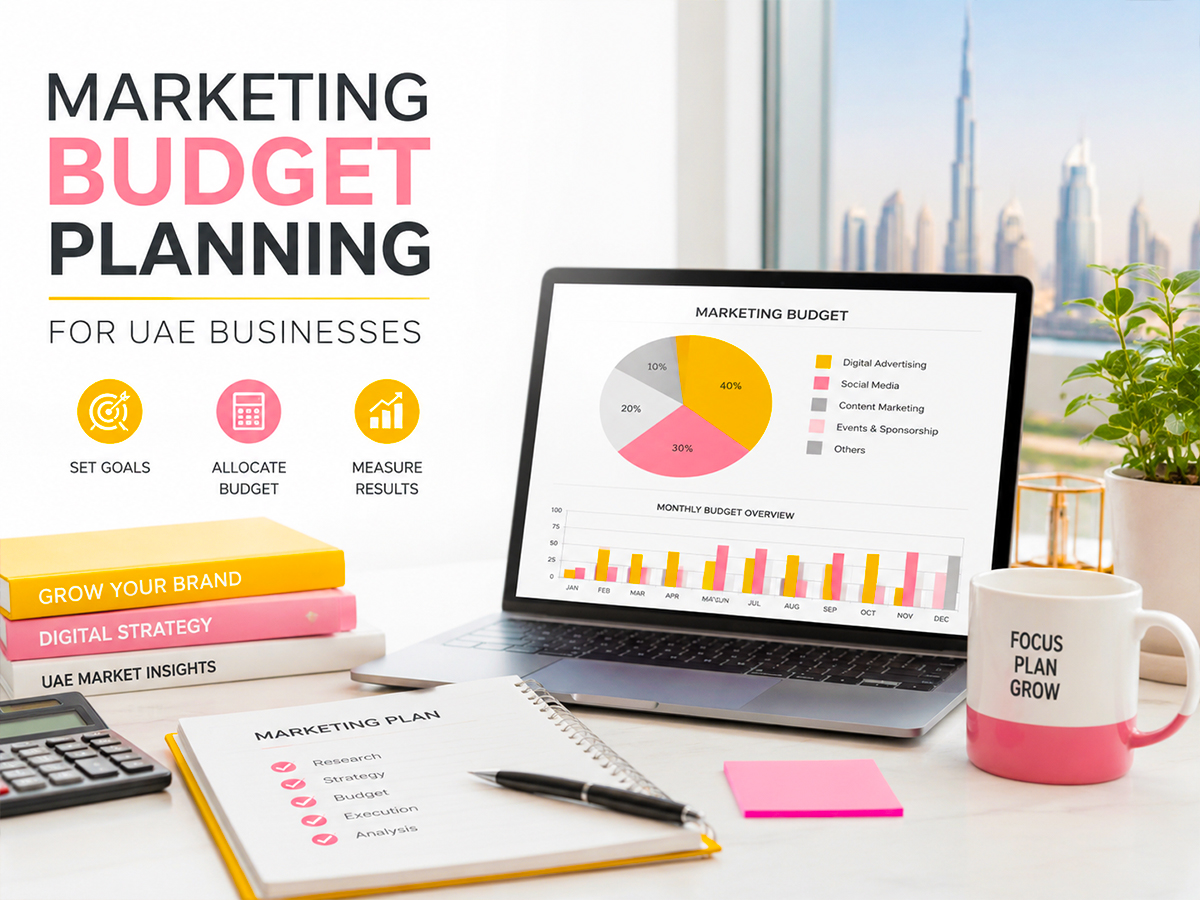
Example Marketing Budget Allocation
Every business has different priorities, but a balanced budget might look like this:
| Marketing Activity | Suggested Allocation |
|---|---|
| Paid Advertising | 30% |
| SEO | 20% |
| Content Marketing | 15% |
| Social Media Marketing | 15% |
| Website & CRO | 10% |
| Marketing Tools & Analytics | 5% |
| Testing & Innovation | 5% |
Diversifying investment reduces risk and creates multiple channels for acquiring customers.
Common Marketing Budget Mistakes
Even businesses with healthy budgets can underperform if spending isn’t managed strategically.
Avoid these common mistakes:
- Investing heavily in paid advertising while neglecting SEO.
- Sending traffic to a poorly optimized website.
- Producing content without a distribution strategy.
- Measuring clicks instead of business outcomes.
- Ignoring customer retention and focusing only on acquisition.
- Setting budgets based on competitors instead of business objectives.
- Failing to review marketing performance regularly.
Successful businesses continuously test, measure, and optimize their marketing investments.
KPIs Every Business Should Track
A marketing budget should always be tied to measurable performance.
Monitor key metrics such as:
- Return on Investment (ROI)
- Return on Ad Spend (ROAS)
- Customer Acquisition Cost (CAC)
- Cost per Lead (CPL)
- Website Conversion Rate
- Organic Traffic Growth
- Customer Lifetime Value (CLV)
- Revenue generated through marketing
These metrics help identify which channels deserve greater investment and which require optimization.
Final Thoughts
Marketing budget planning isn’t about spending more—it’s about investing more strategically.
For businesses across Dubai and the UAE, a structured marketing budget provides clarity, improves accountability, and ensures every marketing dirham contributes toward measurable business growth. By balancing investment across SEO, paid advertising, content marketing, social media, website optimization, and analytics, businesses can build a scalable marketing strategy that supports both short-term performance and long-term success.
At Glomm, we help businesses across the UAE build data-driven marketing strategies that align budgets with real business objectives. Whether you’re launching a startup, expanding into new markets, or looking to improve marketing ROI, our team develops integrated strategies that turn marketing investment into sustainable business growth.
Most small businesses allocate between 5% and 10% of annual revenue to marketing. Businesses pursuing rapid growth or entering competitive industries may invest closer to 15%.
Yes. SEO is one of the most cost-effective long-term marketing strategies because it generates qualified organic traffic, improves search visibility, and continues delivering value long after content is published.
The best-performing channels vary by industry, but a combination of SEO, Google Ads, content marketing, social media, and email marketing generally provides the strongest long-term results.
Marketing performance should be reviewed every month, with budget adjustments made quarterly based on campaign performance, ROI, and business priorities.
Yes. Startups often invest between 10% and 20% of projected revenue to build brand awareness, acquire customers, and establish a competitive market presence.
One of the most common mistakes is focusing all investment on paid advertising while neglecting SEO, content marketing, website optimization, and analytics. A balanced strategy usually delivers better long-term returns.