

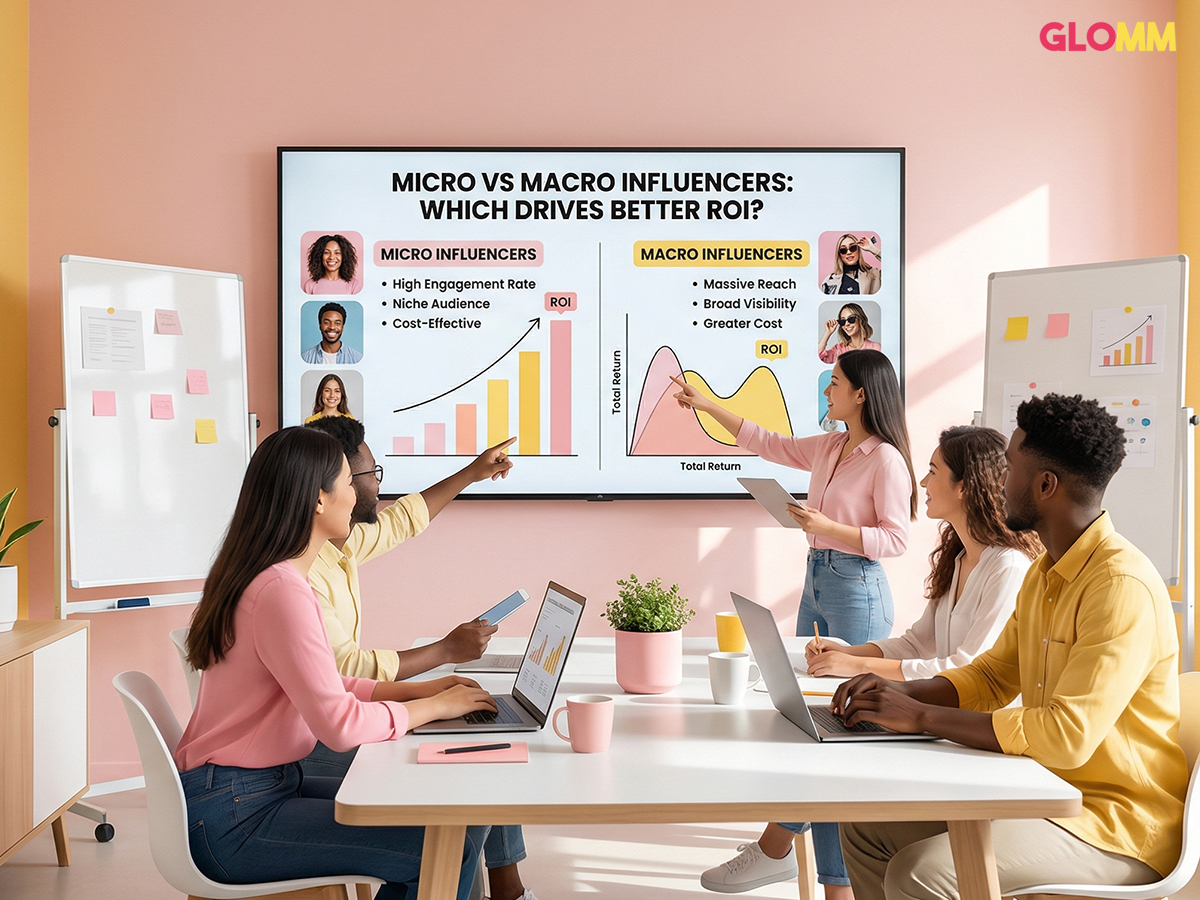
Influencer marketing has evolved—but one debate still remains: Micro influencers vs macro influencers—which delivers better ROI in 2026?
The answer isn’t one-size-fits-all. Both play distinct roles in an influencer marketing strategy, and understanding their strengths is key to maximizing ROI, conversions, and brand growth.
Table of Contents
ToggleUnderstanding the Difference
Influencers are typically categorized by follower count:
- Micro influencers: 10K – 100K followers
- Macro influencers: 100K – 1M+ followers
But the real difference isn’t just size—it’s engagement rate, audience trust, content authenticity, and reach.
In 2026, brands are evaluating influencers not just by followers, but by performance metrics like engagement rate, cost per engagement (CPE), and conversion rate.
ROI Comparison: What the Data Shows
Data reveals a clear trend in influencer marketing ROI benchmarks:
- Micro influencers often achieve 2–5x higher engagement rates
- Macro influencers deliver greater reach, impressions, and visibility
- Micro influencers typically generate better ROI ($5–$10 per $1 spent)
- Macro influencers average $3–$5 ROI per $1 spent
On average, micro influencers deliver stronger cost efficiency per engagement and lower cost per acquisition (CPA), while macro influencers dominate brand awareness campaigns.
👉 Key takeaway:
- Micro = performance marketing (conversions, ROI)
- Macro = awareness marketing (reach, visibility)
When Micro Influencers Drive Better ROI
Micro influencers are powerful because of their niche, highly engaged communities.
They work best when:
- You want authentic engagement and trust
- Your brand targets a specific audience segment
- You need higher conversion rates and sales
Their content feels more relatable and less like advertising, which improves customer trust and buying intent.
This makes them ideal for:
- D2C and eCommerce brands
- Beauty, wellness, fitness, and lifestyle industries
- Local, niche, or targeted campaigns
Why they perform:
Higher trust + niche relevance = higher conversions at a lower cost
In many campaigns, multiple micro influencers outperform one macro influencer at the same budget, especially in conversion-driven marketing.
Micro vs Macro Influencers: A Data-Driven Comparison
| Metric | Micro Influencers (10K–100K) | Macro Influencers (100K–1M+) |
|---|---|---|
| Engagement Rate | High (2–5x higher) | Moderate |
| Reach & Impressions | Limited | Very High |
| Cost per Engagement (CPE) | Low | Higher |
| Cost per Acquisition (CPA) | Lower | Moderate to High |
| Conversion Rate | High | متوسط (Medium) |
| Content Trust Level | Very High | Moderate |
| Best For | Conversions, niche targeting, D2C | Brand awareness, product launches |
| ROI Potential | High ($5–$10 per $1) | Moderate ($3–$5 per $1) |
| Scalability | High (multiple creators) | Limited (budget-heavy) |
Brands in 2026 are increasingly adopting a hybrid influencer marketing strategy, combining micro influencers for performance and macro influencers for scale.
When Macro Influencers Drive Better ROI
Macro influencers bring scale, authority, and mass visibility.
They are effective when:
- You want rapid brand awareness
- You’re launching a new product or campaign
- You need large audience reach quickly
With high-quality, professional content and broader appeal, macro influencers help brands:
- Build credibility and authority
- Increase brand recall
- Generate viral reach and social proof
Why they perform:
Mass reach + visibility = faster awareness and brand lift
They are especially useful at the top of the marketing funnel (TOFU).
The Cost Factor (CPE, CPA & Budget Efficiency)
Budget plays a major role in influencer marketing ROI.
- Micro influencers:
- Lower cost per collaboration
- Better cost per engagement (CPE)
- Lower cost per acquisition (CPA)
- Scalable with multiple creators
- Macro influencers:
- Higher upfront cost
- Higher cost per post
- Stronger for impressions and reach
In 2026, brands are shifting toward:
👉 “10 micro influencers vs 1 macro influencer” strategy
This improves:
- Engagement volume
- Conversion rates
- Overall campaign ROI
Which Influencer Works at Each Funnel Stage?
One major gap in most influencer marketing strategies is funnel alignment.
Here’s what works best:
- Awareness (Top Funnel): Macro influencers
- Consideration (Mid Funnel): Micro influencers
- Conversion (Bottom Funnel): Micro & nano influencers
👉 This is why micro influencers vs macro influencers ROI isn’t a competition—it’s a strategic combination.
What Brands Are Doing in 2026
The most successful brands are not choosing one—they’re combining both strategically.
A typical 2026 influencer marketing strategy looks like:
- Use macro influencers for reach and awareness
- Use micro influencers for engagement and conversions
- Repurpose influencer content into paid ads and UGC campaigns
- Optimize campaigns based on ROAS (Return on Ad Spend)
This layered approach ensures:
- Wide visibility
- Strong audience trust
- Better conversion-driven ROI
Key Takeaways
- Micro influencers:
High engagement, better conversions, cost-efficient ROI - Macro influencers:
High reach, strong awareness, premium brand positioning - Best ROI strategy:
A balanced mix of micro + macro influencers
Conclusion
So, who drives better ROI—micro influencers or macro influencers?
Micro influencers often win on cost efficiency, engagement, and conversions. Macro influencers win on scale, reach, and brand awareness.
But in 2026, the smartest brands don’t choose—they integrate both into a full-funnel influencer marketing strategy.
Because in today’s attention economy: Reach gets you noticed, but trust drives conversions and revenue.
👉 If you’re looking to build a high-ROI influencer strategy that actually drives results, explore our influencer marketing services in Dubai to scale your brand with the right creators.
👉 Want to go beyond awareness and turn campaigns into measurable growth? Discover how our performance marketing solutions help maximize ROI, conversions, and ROAS across channels.
Q. Do micro influencers deliver better ROI than macro influencers?
Yes, micro influencers typically deliver higher ROI due to better engagement rates and stronger audience trust.
Q. Which influencers are best for eCommerce brands?
Micro and nano influencers perform better for conversions and sales, especially in D2C.
Q. Are macro influencers still worth it in 2026?
Yes, they are highly effective for brand awareness, product launches, and large-scale campaigns.
Q. What is the average ROI of influencer marketing?
Influencer marketing ROI ranges from $3 to $10 per $1 spent, depending on strategy and influencer type.
Q. Should brands use both micro and macro influencers?
Yes, combining both creates a full-funnel strategy that maximizes reach, engagement, and conversions.