
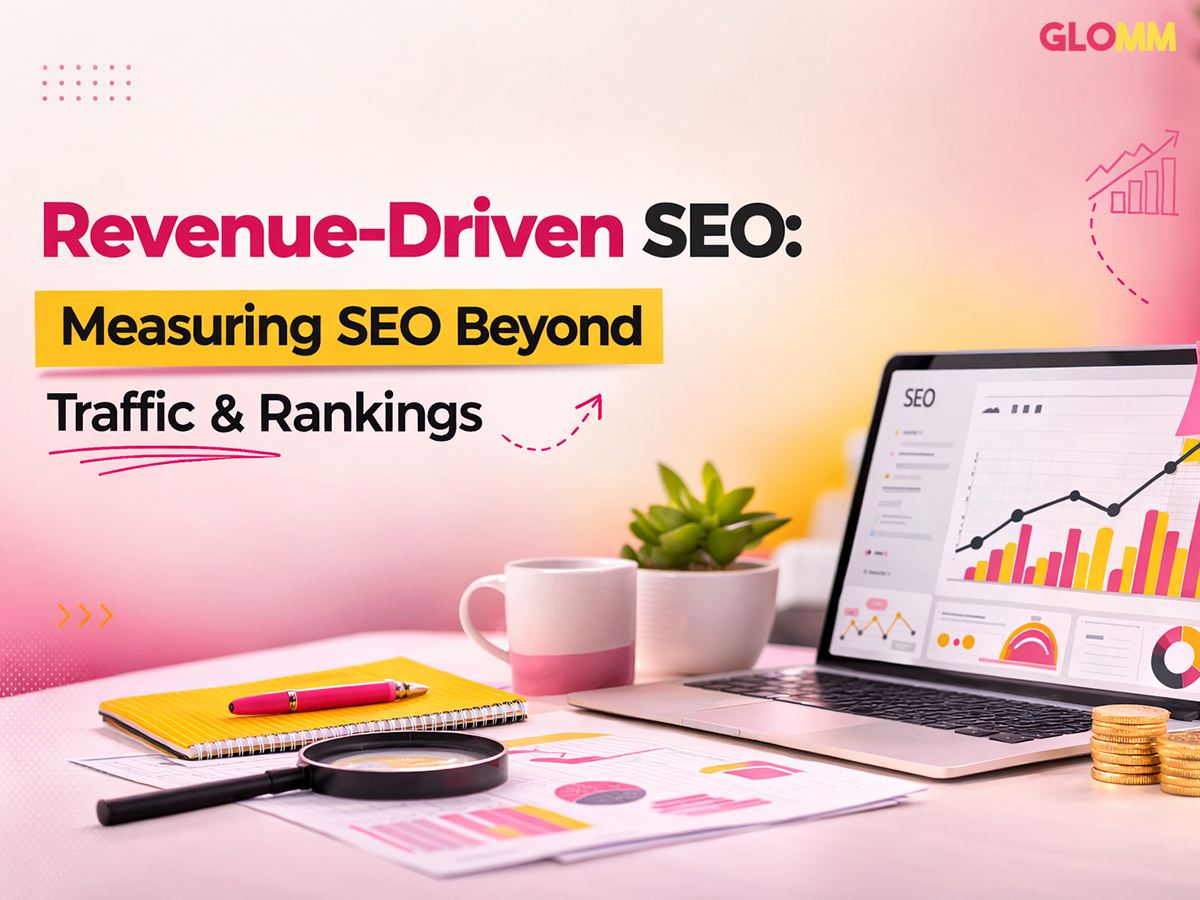
For a long time, SEO success has been measured in two ways:
how much traffic a website gets and where it ranks on Google.
And to be fair, those things do matter. More visibility usually means more opportunities.
But here’s the question most businesses eventually run into:
If traffic is growing… why isn’t revenue?
It’s something we see often at Glomm—websites getting consistent organic traffic, even ranking well for multiple keywords, but not seeing a meaningful impact on leads or sales.
That’s where the idea of revenue-driven SEO comes in.
Table of Contents
ToggleThe Problem With Traditional SEO Metrics
Ranking on page one feels like a win.
Seeing traffic numbers go up feels like progress.
But those metrics don’t always tell the full story.
A website can attract thousands of visitors every month—but if those visitors aren’t taking action, the business impact is limited.
In other words, visibility doesn’t always equal value.
That’s why more businesses are starting to look beyond traffic and focus on what SEO is actually contributing to the bottom line.
What Revenue-Driven SEO Really Means
Revenue-driven SEO is a shift in mindset.
Instead of asking,
“How many people are visiting the website?”
It asks,
“How many of those visitors are becoming customers?”
It’s about connecting SEO efforts to real outcomes:
- Leads generated
- Sales completed
- Revenue influenced
Because at the end of the day, SEO isn’t just about being found—it’s about driving growth.
👉 This is where combining SEO with conversion rate optimization (CRO) and a strong website experience makes a real difference.
Not All Traffic Is Equal
One of the biggest misconceptions in SEO is that more traffic is always better.
But in reality, the quality of traffic matters far more than the quantity.
For example:
- Someone searching “what is digital marketing” is likely just exploring
- Someone searching “digital marketing agency in Dubai pricing” is much closer to making a decision
Both searches bring traffic—but only one is likely to generate business.
That’s why focusing on intent is such an important part of modern SEO strategies, especially when paired with well-optimized landing pages and performance marketing campaigns.
The Metrics That Actually Matter
If you want SEO to contribute to real growth, it helps to look at a different set of metrics.
1. Organic Conversion Rate
This tells you how many visitors from search are actually taking action—whether that’s filling out a form, making a purchase, or booking a call.
Even a small improvement here can have a noticeable impact on results. Often, this comes down to improving landing pages and overall user experience.
2. Revenue From Organic Traffic
Instead of just tracking visits, this looks at how much revenue is coming from SEO.
It helps answer questions like:
- Which pages are driving sales?
- Which content is influencing decisions?
This is where SEO becomes much more tangible—and easier to justify as a long-term investment.
3. High-Intent Keywords
Some keywords bring traffic. Others bring customers.
Focusing on search terms that show clear intent—like “buy,” “pricing,” or “best in [location]”—usually leads to better outcomes than chasing high-volume, general keywords.
This is also where content strategy and SEO need to work closely with business goals.
4. Customer Acquisition Cost (CAC)
SEO is often seen as a cost-effective channel, but it’s still important to measure efficiency.
Understanding how much it costs to acquire a customer through SEO gives a clearer picture of its long-term value—especially when compared to paid acquisition channels like ads.
How SEO Fits Into the Bigger Picture
SEO works best when it’s not treated as a standalone activity.
It becomes far more effective when it’s aligned with:
- Clear business goals
- Strong landing pages
- A smooth user experience
- Conversion-focused content
Because getting someone to your website is only part of the journey. What happens next is just as important.
👉 That’s why many brands today are integrating SEO with web development, UX improvements, and brand positioning to improve overall performance.
Why This Matters in the UAE
The UAE is a fast-moving and highly competitive digital market.
- Users are mobile-first and expect seamless experiences
- Businesses are competing for the same search visibility
- Paid advertising costs are steadily increasing
In this kind of environment, simply driving traffic isn’t enough.
Businesses need to make sure that the traffic they’re getting is actually turning into something meaningful—whether that’s leads, sales, or long-term customers.
Where Many SEO Strategies Fall Short
A lot of SEO efforts still focus heavily on:
- Ranking for broad, high-volume keywords
- Increasing traffic numbers
- Reporting on visibility metrics
But without connecting those efforts to conversions or revenue, it’s difficult to measure real success.
That’s often why businesses feel like SEO is “working” on paper—but not delivering in practice.
The Bottom Line
Traffic and rankings are useful indicators—but they’re not the end goal.
The real goal is growth.
And growth comes from attracting the right audience, giving them a good experience, and making it easy for them to take action.
That’s what revenue-driven SEO is really about.
A Final Thought
If your website is already getting traffic but not seeing the results you expect, it might be worth looking a little deeper.
Sometimes, the biggest opportunity isn’t getting more visitors—it’s making better use of the ones you already have.
And often, that comes down to how well your SEO, content, and overall digital experience are working together.
At Glomm, we help brands implement SEO strategies that go beyond rankings, focusing on performance, conversions, and measurable ROI.
Because in modern digital marketing, SEO should not just drive traffic, it should drive revenue.