
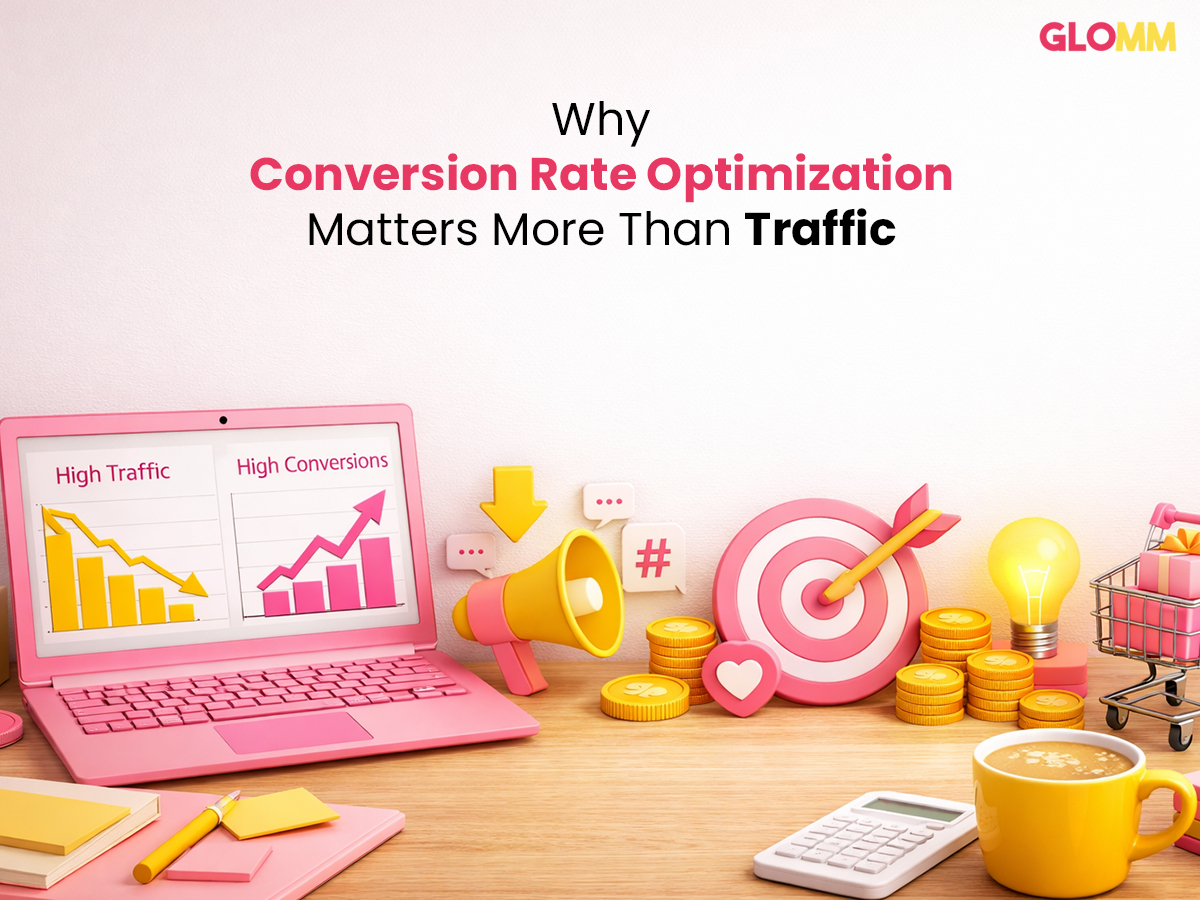
Most brands don’t have a traffic problem. They have a conversion problem.
It’s easy to assume that more traffic equals more growth. That’s why businesses invest heavily in SEO, paid ads, and social media campaigns to bring people to their website.
But here’s the part many overlook:
traffic doesn’t automatically turn into revenue.
At Glomm, we’ve seen this pattern repeatedly—brands driving thousands of visitors every month, but only a small percentage actually convert into leads or customers. That gap is where Conversion Rate Optimization (CRO) makes all the difference.
Table of Contents
ToggleWhat is Conversion Rate Optimization?
Conversion Rate Optimization, or CRO, is about improving your website so that more visitors take action.
That action could be:
- Filling out a form
- Buying a product
- Booking a call
- Signing up for updates
For example, if 1,000 people visit your website and 20 convert, your conversion rate is 2%. CRO focuses on improving that number—without needing more traffic.
Why Traffic Alone Isn’t Enough
Driving traffic through SEO or paid campaigns is important. But without optimization, it often leads to wasted effort and budget.
Most websites convert at around 2–4%. That means the majority of visitors leave without taking any action.
Instead of constantly pushing for more traffic, a smarter approach is to ask:
“How can we get more value from the traffic we already have?”
Even a small improvement in conversion rate can have a big impact on revenue.
A Simple Way to Think About It
Imagine two businesses, both getting 10,000 visitors per month.
- One converts at 2% → 200 leads
- The other improves to 5% → 500 leads
Same traffic, same spend—but very different outcomes.
That’s the real value of CRO. It doesn’t just improve performance—it multiplies it.
What Actually Improves Conversion Rates?
There’s no single fix. CRO is usually the result of several small improvements working together.
1. Clear, Focused Landing Pages
A good landing page doesn’t try to do everything. It focuses on one goal and guides the user toward it.
Clear messaging, strong headlines, and a visible call-to-action can make a big difference. So can something as simple as faster loading speed or better mobile design.
2. Better User Experience
If a website feels confusing or overwhelming, people leave.
Simple navigation, clear explanations, and trust signals like testimonials or reviews help users feel confident enough to take action.
Often, improving conversions is less about adding more—and more about removing friction.
3. Testing What Actually Works
One of the most effective parts of CRO is testing.
Small changes—like a different headline, button color, or layout—can sometimes lead to noticeable improvements. But the key is to rely on data, not assumptions.
Over time, these small optimizations add up.
4. Speed and Performance
Speed matters more than most people realize.
If a website takes too long to load, visitors leave before they even see the content. A faster website doesn’t just improve user experience—it directly improves conversions.
Why CRO Matters Even More in the UAE
In markets like the UAE, digital competition is intense.
- Advertising costs are rising
- Users are mobile-first and expect seamless experiences
- Brands are competing for the same attention
This makes efficiency critical.
Instead of continuously increasing budgets, many businesses are now focusing on getting better results from what they already have—and that’s exactly where CRO comes in.
Where CRO Fits in the Bigger Picture
CRO doesn’t replace SEO or paid marketing—it makes them more effective.
You can drive all the traffic you want, but if your website isn’t built to convert, you’ll always be leaving results on the table.
That’s why CRO works best when it’s part of a broader strategy that includes:
- SEO
- Performance marketing
- Strong website and landing page design
When these pieces work together, growth becomes much more predictable.
The Bottom Line
Traffic brings people to your website.
Conversion optimization turns them into customers.
If you’re investing in marketing but not seeing the returns you expect, it might not be a traffic issue—it might be a conversion one.
And often, fixing that doesn’t require more spend. Just a better experience.
A Quick Note
If you’re curious about how your website is performing from a conversion standpoint, it’s worth taking a closer look. Even small changes can unlock significant growth.
At Glomm, we work with brands across the UAE to improve not just traffic—but what actually comes from it.